Decade of Nightmares by Jenkins Philip
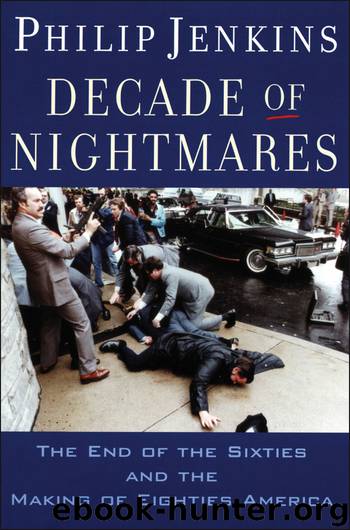
Author:Jenkins, Philip
Language: eng
Format: epub
Publisher: Oxford University Press
Published: 2006-02-09T16:00:00+00:00
Reaganomics
Revolutions occur not because people want them to happen but because the old order is broken so definitively that it is impossible to move in any direction except forward. That observation would certainly apply to America at the start of the 1980s, following the credit crunch and the frightening brush with serious inflation. In retrospect, we know that Carter-era Federal Reserve policies had already begun the process of healing, but at the time, matters looked desperate. In January 1981, Time warned, “For starters, [Reagan] faces an economic situation growing more frightening by the moment.” The prime rate remained between 18 and 20 percent from December 1980 through October 1981, and not until late 1982 did it fall below 12 percent.3
The failure of recent economic policies allowed Reagan Republicans to advance a radical new vision based on deregulation and tax cutting. In their election materials, Republicans mocked the regulations that, they argued, had hobbled America’s natural tendency toward expansion and enterprise, independence and initiative. At every stage, the goal was to restore the centrality of individual moral choice, in economic matters as in personal conduct. As so often in later years, Western imagery was much in evidence. One commercial showed a cowboy tying a portable toilet to his horse before setting off to ride the range, the point being that workplace regulations set wildly unrealistic standards for the provision of sanitary facilities and for so much else. Throughout such rhetoric, we see a gender appeal, rejecting the coddling maternal state that restrains male freedoms. Environmental regulation was condemned because it interfered with property rights and the rights of individuals to pursue their own destinies. Excessive taxes thwarted growth and innovation and had the potential for selective politicized application.4
Reagan offered a bold new economic approach, so radical that his rival in the primaries, George Bush, had dismissed it as “voodoo economics.” (This remark was embarrassing once Bush accepted Reagan’s vice presidential slot.) Somehow, Reagan was planning to cut taxes while launching a huge expansion of military expenditures, all without bankrupting the nation. Basic to the new economics were dramatic tax cuts, and the Economic Recovery Tax Act of 1981 offered across-the-board cuts, together with a cut in the top marginal rate from 70 to 50 percent. Tax cutting was made possible by substantial cuts in public spending, with Great Society–inspired anti-poverty programs taking much of the damage: Medicaid, food stamps, and Aid to Families with Dependent Children all suffered. Even with these cuts, so radically did the administration slash taxes that tax increases were needed the following year, under the euphemism “revenue enhancements.” Booming defense expenditures threatened larger and larger deficits. Reagan lived up to his principle that “defense is not a budget issue. You spend what you need.” The 1986 budget offered a record deficit of $226 billion. Reagan’s anti–New Deal was made possible by the loyal votes of conservative Democratic congressmen, mainly southerners, the so-called boll weevils.5
Fundamental to the new administration was the reduction of federal intervention in society, and not just in the economic realm.
Download
This site does not store any files on its server. We only index and link to content provided by other sites. Please contact the content providers to delete copyright contents if any and email us, we'll remove relevant links or contents immediately.
| Anarchism | Communism & Socialism |
| Conservatism & Liberalism | Democracy |
| Fascism | Libertarianism |
| Nationalism | Radicalism |
| Utopian |
The Secret History by Donna Tartt(19090)
The Social Justice Warrior Handbook by Lisa De Pasquale(12190)
Thirteen Reasons Why by Jay Asher(8910)
This Is How You Lose Her by Junot Diaz(6887)
Weapons of Math Destruction by Cathy O'Neil(6281)
Zero to One by Peter Thiel(5802)
Beartown by Fredrik Backman(5755)
The Myth of the Strong Leader by Archie Brown(5508)
The Fire Next Time by James Baldwin(5446)
How Democracies Die by Steven Levitsky & Daniel Ziblatt(5219)
Promise Me, Dad by Joe Biden(5153)
Stone's Rules by Roger Stone(5088)
A Higher Loyalty: Truth, Lies, and Leadership by James Comey(4964)
100 Deadly Skills by Clint Emerson(4926)
Rise and Kill First by Ronen Bergman(4789)
Secrecy World by Jake Bernstein(4753)
The David Icke Guide to the Global Conspiracy (and how to end it) by David Icke(4720)
The Farm by Tom Rob Smith(4514)
The Doomsday Machine by Daniel Ellsberg(4490)
